
Since the discovery of the structure of Deoxyribonucleic acid (DNA) in 1953, decades worth of research, experiments and studies have gone into creating genetic-engineering technologies. These technologies have been used to benefit agricultural and pharmaceutical industries, as well as food production, but its use on human genomes has grown to be quite a controversial issue.
DNA is the essential molecule found in cells; it contains the genetic instructions for a living organism. These genetic instructions function as the blueprint for natural processes such as growth and digestion. The human genome contains all the genetic information found in DNA organized into 23 pairs of chromosomes.
The pursuit to augment or entirely remove the flaws inherent in the human genome has become a focus in the scientific field of genetics. Interest in applying the technology to the human genome grew exponentially after Dolly the sheep, the first mammal to be cloned from adult somatic cells, was successfully cloned in 1996.
Cloning is often used in the agricultural world to ensure animals such as cows will have favorable traits, such as high milk production or efficient growth, without having to worry about the “genetic lottery.” Some scientific communities have now been researching the benefits of cloning people.
“Certainly, if they were gonna try and clone people, that would not be good,” Linganore High School (LHS) science teacher Lauren Koogle said. “We don’t wanna try to create a human race, or create ourselves again, because it kinda goes against the whole point of the variation of genes.”
Humans themselves have never been successfully cloned, but this concept of cheating the genetic lottery to ensure organisms have more desirable traits has been applied to humanity before. A time when this theory was applied to humans was during the eugenics movement of the late 19th and early 20th centuries.
Eugenics, as defined by the Merriam-Webster Dictionary, is “the practice or advocacy of controlled selective breeding of human populations to improve the populations’ genetic composition.” A variety of subjects can fall under this term, including genetic modification.
“The belief was you should not let the ‘undesirables’ of society reproduce,” Linganore history teacher Dawn Murphy said. “[Those were] people with mental disorders [or]people with criminal behavior. We tried to engineer society. We were sterilizing people in mental hospitals and in prisons. We were in lockstep with [the Nazis] for a while.”
The eugenics movement first became popular in the United States during the “immigration crisis” in the late 19th century. Anti-immigrant beliefs during this time seeped into several aspects of society, and various laws were put in place to restrict the rights of immigrants. These included instituting national quotas against Eastern and Southern Europeans, literacy tests, and barring anarchists, beggars and those with epilepsy from entering the country.
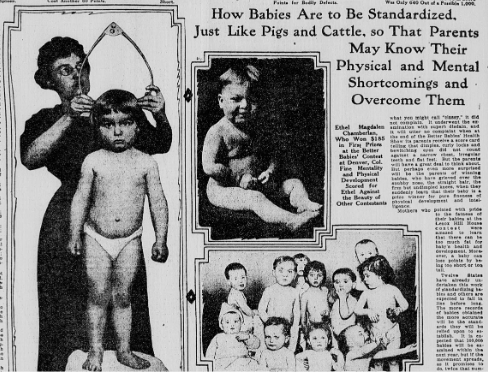
During the height of the eugenics movement, under the guise of being concerned about infant mortality rates, Better Baby Contests were held to judge the physical development and general welfare of a child. Also held were Fitter Family Contests, conducted at state fairs, where entire families would be given physical and psychological examinations by doctors based on eugenic standards of human fitness. If families fit the arbitrary standard, they could win trophies.
The philosophy of eugenicists initially fell out of favor with the public following the events of World War II, but in recent times such beliefs about the optimization of the human race and the pursuit to design humans that fit unachievable standards of perfection have re-emerged, primarily in the form of genetic optimization.
Most recently, there has been a resurgence in the push to genetically optimize human babies while they’re developing as embryos in the womb. In 2018, a scientist in China, He Jiankui, announced that two female twins by the pseudonyms of Lulu and Nana had been born. Jiankui had edited the genomes of these children in an attempt to grant them a genetic resistance to HIV. This raised various ethical concerns in its wake, and the experiment was deemed “not medically necessary.” Despite this, Jiankui stood by his experiments, stating the families “needed” the technology.
While there has not been a repeat of the He Jiankui affair, tech companies and CEOs have gradually been pushing for genetic modification of embryos to be reintroduced and perhaps even popularized in wider society, despite the scientific community continually restating doing so would be irresponsible. According to an article by The Wall Street Journal, published in November of 2025, small tech companies funded by billionaires have been actively looking to create genetically engineered babies.
“There would have to be safeguards in place [with genetic modification],” Murphy said. “We’re not trying to create superhumans and things that could harm other people. Human beings aren’t designed to be perfect.”
The arguments against genetic modification are primarily based on the fact that the technology available for such experiments is too new to be properly understood, and it would be “irresponsible” to subject human embryos to these technologies and conditions.
On the other hand, those who support human genetic modification say it will prevent babies from being born with diseases without cures. Others say it can be used to reverse declining birth rates by giving people a way to improve their fertility, design children to be born with traits the parents want, and to prevent children with physical and mental disabilities from being born.
Similar discussions also arise with the topic of human cloning. While therapeutic cloning can be used to generate organs and tissues for those needing transplants, and the idea has even been pushed to implement cloning for those who otherwise cannot have children, a widespread implementation of such technologies could result in shallow gene pools among families who abuse cloning.
Koogle elaborates on the consequences of employing cloning technologies to have children.
“For example, if they were cloning a certain type of tree, you’re basically preventing any different types of variety,” Koogle said. “Everything would be all the same, and diseases could wipe out an entire population because there would be no mutations and variety [to potentially withstand the disease].”
Genetic modification and cloning remain contentious issues. While they can be implemented for good and for the betterment of mankind, they have very limited uses and can quickly be turned around and used in ways that may negatively impact society.
“History repeats itself; it comes full circle,” Murphy said. “Humans were way too complicated [during the early eugenics movement]. Well, humans aren’t as complicated anymore. And, if there’s money to be made, the non-ethical practices are going to get in there.”