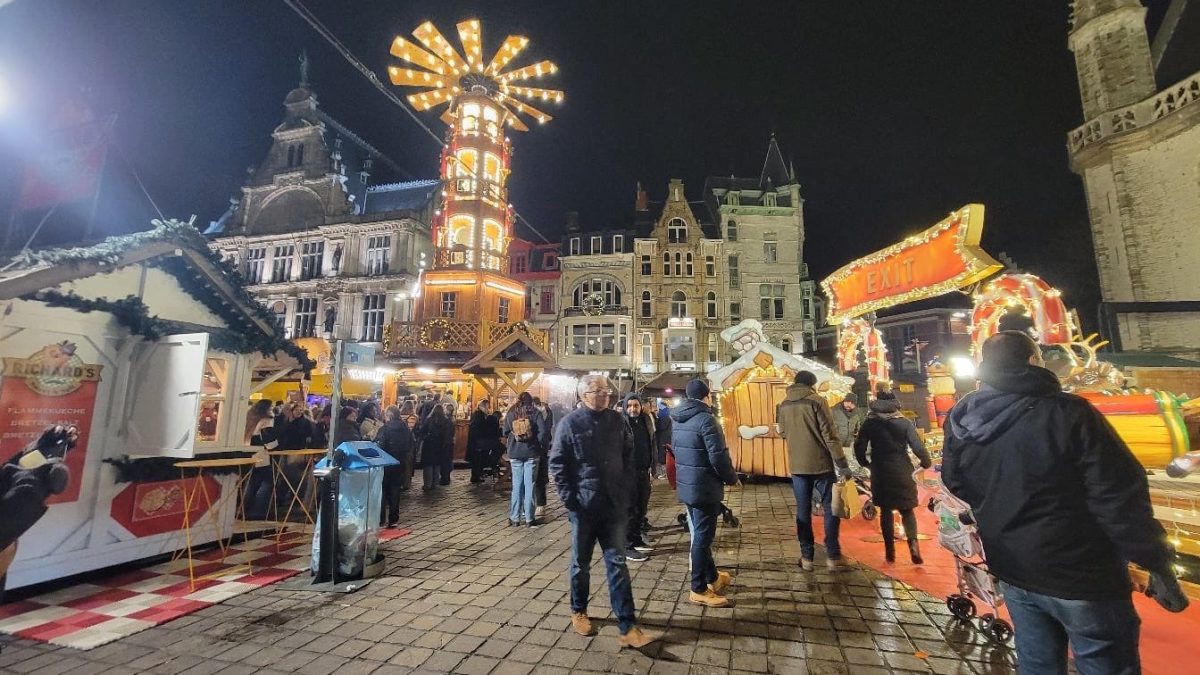
Every European country that holds Christmas markets offers something.
In France, one can find Tarte Flambée (spiced cake) and Pain d’épices (spiced bread).
Similarly, Belgium sells Belgian waffles, along with speculoos (spiced biscuits.) One added highlight of the event is a light show in Brussel’s city square.
Switzerland’s market features a paragliding Santa, who flies over Geneva daily during the market season, providing a festive Christmas attraction with a unique Swiss touch.
Whereas in Prague, Czech Republic, visitors of the market can purchase Pražská šunka (Prague Ham).
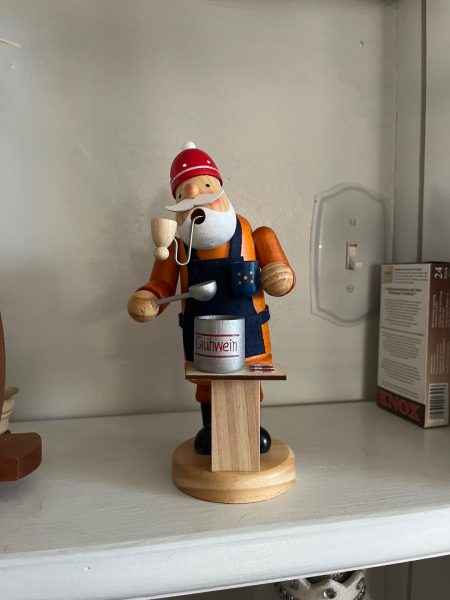
Germany and other European countries have a popular product called Räuchermänner: wooden incense burners.
The incense burners are little hollow men with two parts, one being the base part to hold the lit incense, and the other being the rest of the burner, creating smoke that comes out the mouth hole of the man.
With each of these distinctive aspects, the buildings that hold the vendors and their products almost all look alike. The wooden stalls or huts have festive lights, garlands and often resemble miniature chalets–a type of building style with a steep, overhanging roof designed to withstand heavy snowfall.
Baltimore, Maryland is home to the city’s own recreation of a German Christmas market, but how similar is it to an actual Christmas market in Germany?
Baltimore’s Christmas market, known as the Christmas village in Baltimore is located in West Shore Park, Inner Harbor, near the National Aquarium and is open from November 22 to December 24.
The Nuremberg Christkindlemarkt (Christmas market), the inspiration for Baltimore’s Christmas market, is centered around the Hauptmarkt (main market square) and runs from November 28 through December 24.
Like the other countries’ defining features, Germany has their own, from which Baltimore takes its own inspiration.
Baltimore’s Christmas market has themed weekends which are distinct to Baltimore’s market, the most popular being the German-American weekend with dancers dressed in Drindl’s- the most well known attire, being worn as festive garments.
“Like the other countries’ [Christmas markets], they give you cups, but the German ones are specifically known for their mugs, and they’re collectible,” Belgium citizen Shawna Messersmith said.
Messersmith is referring to the Glühwein mugs one receives when they purchase Glühwein–a type of heated, spiced red wine, which has been around since about 1420.
Like Germany, Baltimore offers their own version of Glühwein and other spiked spiced beverages in their own specialy-designed mugs.
Baltimore, along with Germany, change their mug designs and its color each year, while maintaining the iconic boot shape of the mug. These designs include the location the mug was purchased, as well as the year. while Germany plays it safe, Baltimore tends to switch up more design elements and plays with variations in shape.
Nuremberg’s market is much larger in regards to Baltimore’s; it covers approximately 2.4 miles in distance, while Baltimore’s is around 180 feet long and 60 feet wide,
Nuremberg has around 180 vendor stalls, while Baltimore only contains around 60 vendors.
European Christmas markets have rows of buildings, creating a walkway for people to navigate and experience everything without having to go to greater lengths to find something.
The layout of Baltimore’s market looks a bit different. The map of Baltimore’s market shows vendors are spread out further. The area most similar to other European markets covers vendor stalls number 1 through 30. The difference in set-up is likey due to Baltimore’s venue being designed for festivals and gatherings, while German Christmas markets are normally placed in town’s squares.
Amy Russell, a Belgium citizen has been to multiple Christmas markets, mainly going to ones in Belgium, like Brussels and the town of Aachen, some being in Europe and one in The United States in Texas.
“Comparing the Brussels Christmas market to the Aachen Christmas market I think that it’s just a different kind of organization and preparedness with a lot more stalls than other markets normally,” Said Russell. “Even the ones that are in France, they’re pretty organized as well. I’ve been to Germany, Austria, Belgium, France, Ireland, UK, and USA, but I would say that the German ones are the most organized and put together and have the most variety for things like shopping.”
Overall, with the two Christmas markets being compared, Germany tops Baltimore’s market. In organization, authentic foods and drinks, and crafts.
Even when Messersmith was asked which out of the multiple she had been to she stated, “Cologne is the best one. It’s unmatched, it’s crowded, but it’s worth it.” Showing even out of all the other unique European countries, Cologne in Germany is the best.