
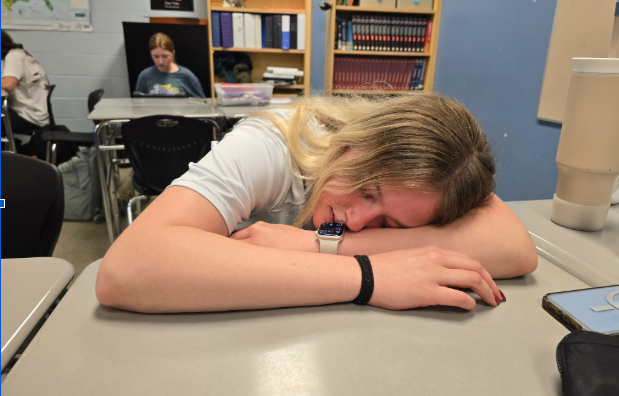
As most people know, students sleeping in class is a common problem in almost any classroom. There seems to be at least one person with their head down, sleeping on their desk.
When asked, most students at Linganore High school have admitted that they have slept in class at least once. However, the reasons for sleeping late varied between students and teachers at Linganore. Some teachers believe its social media, while students could argue that its homework amounts, or the need to get up so early.
Even some medical sites provide research backing one of the claims that schools start too early.
According to Johns Hopkins Medicine, teenagers should be getting at least nine to ten and a half hours of sleep each night. This means they should be getting into bed and sleeping before 11 p.m. However, with buses coming around 6 a.m, it causes students to be up early which results in later sleeping times.
Linganore Highschool freshman (LHS) Luis Molina disagrees with Linganore’s early start time for high school.
“I do believe school starts too early,” Molina said. “I’ve seen studies that say that schools that start at 10:15 or later tend to have better [student] moods and better outcomes when it comes to developments.”
LHS sophomore Taylor Queen also believes that school start times are too early, although she did admit her lack of sleep was partially her fault for staying up too late.
“Sometimes I binge watch TV shows, and that keeps me up at night,” Queen said.
This claim is further backed up by a survey conducted in 2021 by the American Psychological Association (APA) which states that 69 – 77% of students in high school fail to get enough sleep due to heavy homework loads, as well as the impact of neurological diagnoses like ADHD and Autism.
Queen also blamed her lack of sleep on homework.
“It’s 7 a.m,” Queen said. “I’m staying up doing essays and homework. There’s too much!”
In addition to heavy academic work loads, teens do face other obstacles to going to sleep in a timely manner. For some, it is work keeping them up so late.
LHS junior Nick Weatherly is one example. He said that outside factors such as his Career and Technology Center (CTC) homework and construction work are both reasons he is up late.
Weatherly said that he gets a good amount of sleep, “about eight hours,” despite his multiple commitments: daily life activities such as lifting and hanging out with friends. Though it is a good amount of sleep, this is still less than the recommended number of hours.
On the other hand, some members of the LHS community do not think that school start times are too early. LHS football coach and science teacher Christopher Turner is one of those people.
He believes that students sleep in classes for many reasons and some of those reasons may be the students’ fault.
“Kids nowadays have these cell phones and computers, and they are staying up late at night,” Turner said.
Turner believes that if school start times are moved back, students will just stay up even later.
Jamie Hendi, an LHS government teacher and former lawyer, believes that kids sleeping in class was due to them playing games, scrolling social media and talking to friends.
“Some kids are overextended, and they are doing too much [activities]” Ms. Hendi said. “They are just engaged with whatever it is that they are doing and not going to bed.”
Like other students, LHS senior Hamid Sesay, agrees that school start times are too early and supports the idea of pushing start times later.
According to Sesay, the circadian rhythm (basically your body’s internal clock that regulates functions like sleep schedule hormone release and body temperature) was disrupted by early start times. For Sesay, this is most apparent in his first period, where he felt as if he were barely there.
Getting sleep as a teenager is one of the most important things for the growth and development of those teens. However, most kids are not getting that sleep for their brain and growth.
According to the National Sleep Foundation (NSF) the circadian rhythm is affected each time a teenager stays up. Every time they stay up, they get tired even later. This causes an endless cycle of teenagers staying up late, and having their sleep schedule ruined.
Without sleep, it could cause problems like lack of focus, dropping grades, mood swings and sleeping in classes.
Though opinions differ between students and teachers to solve this problem, it is evident that teens nowadays are not getting the required 10 hours of sleep, either due to external reasons such as homework and work, or reasons like gaming and social media that keeps kids up at night later than they should be.