
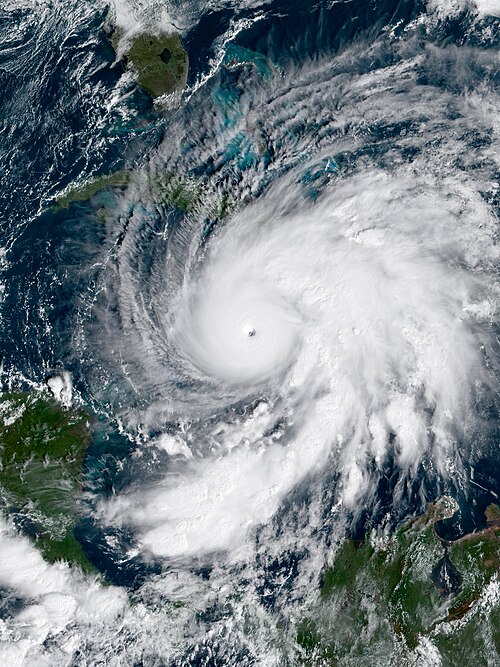
Hurricanes are powerful storms which form in the ocean and have winds of at least 74 miles per hour (mph.)
According to —National Geographic Kids , they are known by the name “hurricane” because they form and occur in the Atlantic Ocean, Caribbean Sea, eastern Pacific, and Gulf of Mexico. If they occurred in the western Pacific Ocean they would be known as typhoons, while in the southern Pacific and Indian oceans they would be known as cyclones.
Hurricane Melissa is a major hurricane that formed in the Caribbean Sea. It rapidly increased in wind power as it beat records set by previous hurricanes in Jamaica.
There are two key measures used to rank hurricanes: one, their maximum sustained speed, and two, their minimum pressure. The Weather Channel says that the strongest hurricane in terms of minimum pressure is Hurricane Willma, which was a hurricane that occurred in 2005 and reached 882 millibars.
Millibars are what meteorologists use as units for pressure. An average sea level pressure is 1013 millibars. Can you explain what having low pressure does then?
Also according to The Weather Channel, the second strongest hurricane in the same terms as minimum pressure is Hurricane Gilbert on record in the Atlantic Basin, which occurred in 1988 and reached 888 millibars. Lastly, the third most powerful hurricane is known as the “Labor Day” Hurricane in 1935, which reached 892 millibars.
Despite these rankings, it is possible some earlier hurricanes were stronger, but this information is not known due to the lack of technological advancements at the time to measure factors such as low pressure.
When considering wind speed, the strongest hurricane measured in miles per hour (mph) is 1980’s Hurricane Allen, which boasted wind speeds up to 190 mph. The second through fifth strongest are all tied at 185 mph; they include the “Labor Day” Hurricane in 1935, Hurricane Gilbert in 1988, Hurricane Wilma in 2005 and Hurricane Dorian in 2019.
As Hurricane Melissa joins these ranks, it is already beating many records.
According to Climate Central, Hurricane Melissa reached winds of 185 mph and was upgraded to a category 5 hurricane on October 27, 2025.
“There’ll be a lot of studies of it because it’s probably one of the strongest storms we’ve observed in the Atlantic,” previous director of the National Hurricane Center Bill Read said.
To-date, Hurricane Melissa has had the largest impact on Jamaica, surpassing their previous strongest, Hurricane Beryl in 2024.
According to an article on the history of hurricanes and floods in Jamaica, the reason why this is such a big deal is because Jamaica has been a target of hurricanes dating back to 1559.
Amber McCauley, an environmental science teacher at Linganore High School (LHS), said that this was a really severe hurricane, and with Jamaica not being a very rich country, it made a lasting impact on it.
Contributing to its diminished economic status , Hurricane Melissa also took a big toll on Jamaica’s tourist industry in the South, which constitutes a large part of Jamaica’s income.
According to a CBC news article, Hurricane Beryl passed south Jamaica as a category 4 hurricane in 2024, while the more recent hurricane Melissa passed over Jamaica as a category 5 in 2025.
Hurricanes have different categories based on their strengths, and the final, strongest category is category 5, says a Graves Thomas article
Not only has Hurricane Melissa passed Jamaica, causing a mass of destruction in homes and agriculture while killing 45 confirmed people, but it has also passed by Cuba. There, Hurricane Melissa had weakened into a category 3 and 735,000 people evacuated before October 29, 2025 when Hurricane Melissa made landfall. No deaths are on record, however, the destruction caused by the hurricane and damage caused to water systems led to a lot of Cuba’s population getting sick, explained a CDP article.
An article from Center For Climate And Energy Solutions shares that hurricanes seem to be getting more severe as global warming increases. They are increasing in intensity and traveling at lower speeds, which ultimately causes more destruction. In addition to this, a rise in sea levels caused by climate change and global warming worsens the flooding caused by hurricanes, leading to a further increase in deaths and destruction.
Read said that during October, and in the central and Western Caribbean, some of the warmest water of the season exists, and that warm waters are a fuel source for strong hurricanes like Melissa.
An example of this that Read gave was that there was a hurricane, hurricane Mitch, that formed around the same time and just a little south of where Melissa was formed in 1998 and many people don’t remember its intensity because it moved really slowly and weakened before it hit land.
Hurricane Melissa has now caused at least seven deaths and continues to increase and move along to new areas.
Linganore biology teacher Beth Erickson, a teacher at Linganore High School shared her concerns “That they’re [hurricanes] worsening, that we have more devastating hurricanes than ever before.”