
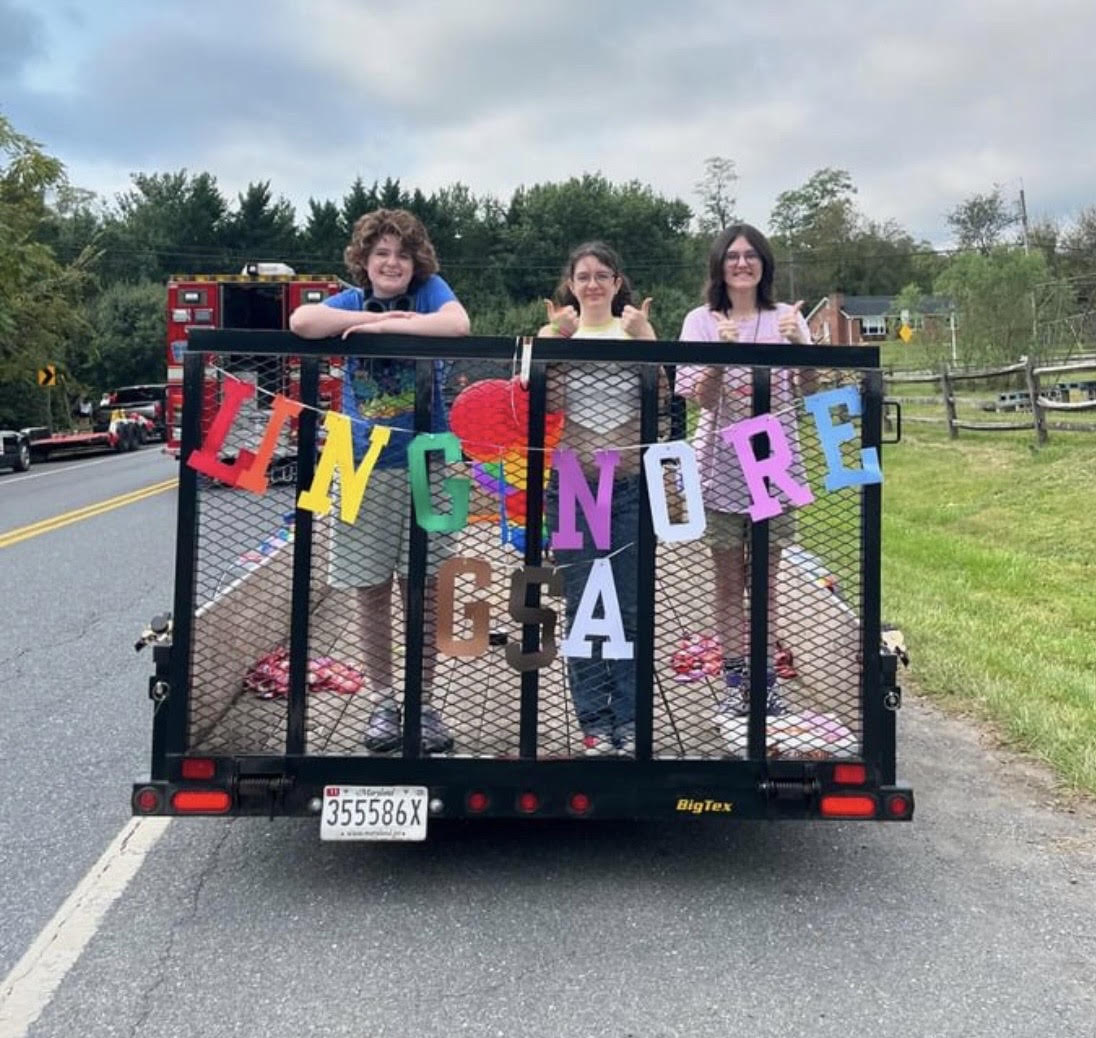
The annual Winter Formal hosted by Linganore Highschool’s (LHS) Gender Sexuality Alliance (GSA) has been used to fund a donation to a charity each year. Due to lack of ticket sales and insufficient funds to hold the dance, the event was cancelled.
Linganore has had a GSA for over a decade now, with the goal of creating a safe space for LGBTQ+ students who attend Linganore. The recent cancellation, however, has raised some questions.
It is not clear why there was little interest in the event this year and so few people bought tickets, but speaking to the current club advisor, Kathleen Shields, highlights one possible problem.
“People don’t use Schoology, and that’s the best medium for me,” Shields said. “I sent out an announcement … but if you never read the notices coming from the advisor that kinda makes it not very helpful.”
Additionally, a lack of sufficient advertising for the event may have also contributed. While there were posters put up across the school and mention of it in the morning announcements, LGBTQ+ students at LHS who are not part of the club indicate it may not have been enough.
“I was entirely unaware of [the Winter Formal] to be honest,” sophomore Sam Sayer said.
Current president of the GSA, Isabelle Zieg-Sniffen, believes that there is a much simpler reason for the outcome.
“The main demographic is our own club,” Zieg-Sniffen said. “If our own club isn’t going to buy tickets then there is no dance … our club was just too small.”
This raises the question: why does the Linganore GSA have such a low member count in the first place?
The previous GSA advisor of 12 years, LHS science teacher Jessica Walker, says that the club has not always been this way, but has been slowly losing members over the course of the past few years.
“We had a year where it was 96 students,” Walker said. “We were the largest GSA in Frederick County, which is pretty respectable.”
Even just four years ago, the club had 80 members, a stark change from the current count of 32 members. Former GSA Officer Janette Astrafall said that when the club had more members, things felt more open and everyone was friendly with each other.
“It was more of an open group, so you could talk about virtually anything … we were pretty open so we discussed a lot of things,” Astrafall said.
In recent years, however, the club environment has changed. Current members report that the club feels emptier and less like a community.
“There was more of a chain of people who knew each other joining, and then creating a bigger community,” junior GSA officer Millie Hamilton said. “I feel like that’s changed.”
Another possible reason for decreasing membership was raised by senior LGBTQ+ student V. Martinez. He has peers within the club but chooses not to be in it themselves due to a fear of facing homophobia.
“[Being a GSA member] puts a label on you,” Martinez said. “I’m just not exactly comfortable, considering my family and other people that I hang out with who aren’t so approving.”
A few members of the club, like Junior Spencer Baldomar, have also reported experiences with homophobia and transphobia from other students. Baldomar stated that since he became open about being transgender, many students will go out of their way to use his legal name in order to make him uncomfortable. Baldomar also stated that club members were often teased as a result of being in the club, often during passing periods in which students were waiting for a staff member to unlock the room where club meetings were held.
“[Some students saw] a lot of students that they recognize are queer … waiting for a staff member to unlock that area,” Baldomar said. “I heard a lot of people whispering behind our backs, saying transphobic remarks … and trying to overall tease and yell really mean things at the group.”
One of the most significant incidents of homophobia occurred last year, involving former GSA Officer Eddie Nunley in which both parties were suspended. According to Nunley, a group of girls repeatedly made transphobic remarks and threats towards Nunley, culminating in a physical altercation in a girls restroom. However, even after they were broken up and consequences were given, Nunley still had some lingering worries.
“Some of the girls had yelled that they were going to kill me, so for a few days after that I was on lookout for people trying to hurt me,” Nunley said. “I was just kind of tense … [there were] more people that came to me in the hallways yelling my deadname.”
GSA president Zieg-Sniffen provided another perspective on the issue, theorizing that the presence of homophobia at Linganore has recently decreased. She says that she hopes this is the case.
“I’d like to say [it’s gotten] better, just because there are more people and … our school feels more diluted,” Zieg-Sniffen said. “You know how this school is seen … but the more people that come into this school, you’re gonna find more nice people.”
Walker echoed this sentiment, theorizing that she thinks students do not feel the need to join the club because it is no longer a necessary place for queer students to have a safe community in their school.
“I think part of the reason is that … there may be other groups that are meeting their needs instead of finding a safe space in GSA,” Walker said. “Being LGBTQ is a little bit more normalized than when I was in high school.”
This seems to be the case for some students, like sophomore Sam Sayer, who expressed that he has places where he feels safe to be himself despite not being part of the club.
“I’ve got a few classes that I feel safe with and a few … friends that I genuinely feel safe with being who I am,” Sayer said.
Hamilton finds himself on a middle ground regarding the issue. He believes that homophobia has gotten better in certain aspects, but also possibly worse in others.
“There was still the Policy 443 walkout, and even before I came here I heard that there were previous [GSA] officers being bullied for being in the club,” Hamilton said. “Its also gotten better in the sense that I haven’t really heard of bullying of that nature.”
Hamilton also mentioned Policy 443, which is an FCPS policy that is meant to ensure the comfortability of gender-nonconforming students. Many elements of this policy are extremely controversial, such as using students’ preferred pronouns and allowing students to use the bathroom that aligns with their gender identity. Due to this controversy, there was a student held walkout done at multiple FCPS schools against this policy, which has led to many LGBTQ+ students feeling unsafe, and contributing to students not wanting to join the GSA and be open about their identities.
“I personally did not attend [the walkout]… I didn’t exactly feel safe doing that,” Martinez said.
Baldovar also did not agree with the Policy 443 walkout, and he formed a protest against transphobia related to Policy 443 that gained a lot of support.
“I am friends with people who fall under the LGBTQ umbrella in some way, and they all felt unsafe,” Baldovar said. “I decided to see if I could make a change and … I got permission from GSA officers to give a small speech about the protest [for the club].”
Maintaining this policy and the enforcement of it has been an ongoing fight for transgender students and the Linganore GSA, former GSA Officer Janette Astrafall said that advocating for it was a continuous issue that she had to face while leading the club. She and the other officers worked continuously to push for various accommodations for students who needed them and was able to make some progress before her graduation in 2024.
“Policy 443 was my biggest problem; I’m not even gonna lie to you,” Astrafall said. “We managed to keep pushing, and we did get some change to happen, which was getting [gendered bathroom signs] removed in the [assistant principles] office and … both were given women and male [hygiene] necessities.”
The club also underwent a large transition this year, with Shields taking over as the advisor after Walker stepped down. Walker is extremely well-liked within the club and the student base in general, and it is possible that this change in leadership may have driven away some people who were previously in the club.
“I just know there was a change in me versus Mrs. Walker, and people knew her and were comfortable with her,” Shields said. “I’m like a new entity.”
Shields stated that there has been discussion of changing the advisor again in the next school year, after LHS staff member Angela King McGavin reached out to her and offered to take over and help out.
“I know a lot of [queer] kids, so I thought maybe I could get them in [the club],” King McGavin said. “I thought that would … help [the club] be a little bit stronger.”
Generating new interest in the club moving forward would be beneficial due to its importance to the student body. In her role as former advisor for the club for many years, Walker has been a first-hand witness to the help that it can bring to students.
“I think it’s important to give students a place where they can just truly be themselves and not feel judged by other students,” Walker said. “It’s a good support system for students who may not have that acceptance at home or may need extra resources.”