
Artificial Intelligence, more commonly known as AI, can do many things, from generating a story to answering an everyday question. Over the years, access to this technology has only grown. Teachers, students and studies have different ideas of how access to AI affects student learning and critical thinking.
A study by the Multidisciplinary Digital Publishing Institute (MDPI) focused on AI use and its correlation with critical thinking. They found that people who rely on AI received lower scores on critical thinking exercises used for this study than those who do not, when no AI is available to them. This shows that over reliance on the technology can worsen independent thinking skills.
In fact, Of the students in the MDPI study, 57.6% say they use AI weekly to help on school assignments. While only 1.2% of students say they have never used AI for this purpose.
Another study by the Center for Democracy and Technology (CDT) analyzed perspectives of parents, students and teachers regarding students’ reliance on AI. According to the study, 72% of parents and 71% of teachers who responded, believed students who rely on AI are more likely to be losing key skill sets necessary for daily life. As for the students participating in the study, almost two-thirds admitted to using AI to help with school work, reinforcing the fact that has become a common issue in schools.
A student at Linganore High school (LHS) said one reason for this could be that “It [AI use] teaches [students] that they can always rely on something else to do something for them,” freshman Violet Vidt said.
Another point raised by 71% of teacher respondents in the aforementioned study was how it has become harder and harder to differentiate AI-generated work from authentic student work.
Aaron Burch, a social studies teacher at LHS, agrees with this statement.
“If people continue to use it [AI] to mask their own work, then we have huge problems,” Burch said. “And it’s really, unfortunately, hurting people that are using it.”
Another study by MDPI on AI’s effect on learning concurs with Burch’s opinions. It demonstrates that over reliance on AI for learning can cause a loss in critical thinking skills in students.
Alexis Anzmann, an English teacher at LHS, believes that AI can be problematic for students to use.
“I think it’s just a very slippery slope,”Anzmann said. “I think it can be dangerous. We’re already seeing how it’s taking away from independent thought [and] critical thinking.” Like giving students the option to not have to exercise these skills, and instead use AI to do the work for them.
One cause for the overuse of AI may be a result of school rules for AI across the country not being consistent. This leads to inconsistent enforcement, from class to class or school to school, which leads to students not following the rules in place. For example, according to 53% of the students in the MDPI study, they have used AI on an assignment after it was prohibited for them to do so. However, the CDT study shows 46% of teachers surveyed indicated their schools are leaning toward allowing AI usage for classes for the 2024-2025 school year. This data shows how the excess use of AI has negatively impacted student integrity, an important life skill.
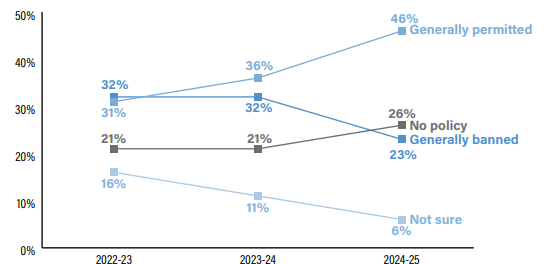
Burch’s personal experience in his classroom reinforces the fact that AI use with academics is not enforced consistently throughout the school.
In regards to AI use in his classroom, Burch said, “It’s treated basically just like plagiarism.” I[‘m] usually … honest and tell them how I find it [after catching them using AI].” Depending on the severity of the usage of AI on the assignment, generally Burch will award the student a 0% on the assignment.
Anzmann’s experiences corroborate Burch’s view that the rules are inconsistent and not enforced in the same way throughout the school.
“[It is] expected that students are not using any [AI] on their assignments unless you know the teacher has approved some sort of AI,” Anzmann said. “I think some teachers might be a little bit more willing to [let students] use it [AI] … but I doubt we’re all on the same page.”
Students at LHS similarly believe the rules surrounding AI use in academics are not equally enforced.
“You’re not supposed to [use AI], but people definitely do,” says Vidt.
LHS Teachers and students have come to the same conclusion in regards to the loss of critical thinking skills, social skills as well as a want to learn.
As to why students use AI when it is known to lower critical thinking skills, LHS teachers say it is a quick way to get answers and is generally found to be easier than thinking for oneself. Students agree with teachers about why it is common to use AI instead of doing ones own work.
“It’s [using AI is] easier than to actually think and try yourself,” said Vidt.
The CDT study found 50% of students acknowledged that using AI in school has made them feel less connected to their teachers. This shows that reliance or overuse of AI has caused them to lose social skills as well critical thinking skills.
Despite this, Vidt shared her perspective that students prefer using AI rather than learning from their teachers because it is much easier to look up an answer than actually speaking up and asking a question, ultimately impacting social skills such as communication and participation.
As cited by the CDT study, more than half of teachers and parents worry about their students using AI tools to learn–especially those not originally made for learning like Chat GPT, which is found to put out deceptive, false answers by The Harvard Independent.
This suggests another issue brought to light in the study, which is students’ tendency to take all information received from AI at face value, without questioning what they are reading. Approximately 7 in 10 teachers surveyed, agree that students never doubt AI’s credibility. This further proves that the critical thinking skills are being lost.
Although teachers and students alike believe that AI can be useful at the right time and place. Teachers and students know that AI can be helpful but only to a certain extent, particularly when students have no background knowledge on the subject they are using AI to help them with. If this is true, students are much less learning and more so just getting answers.
While Burch concedes there are “good and bad” aspects of student AI use, he believes that students can use it to amplify their learning, but it should never be used to replace it.
“If you’re going to use it as an instructional tool, it can be good if you need it in a pinch, but not to use it to answer things when they [students] don’t have any idea what’s going on,” Burch said.
Anzmann agrees: “There’s a lot of really good uses for it, but I think it’s also very, very dangerous,” if used to the point where important skills are in jeopardy.
It seems to students that AI can help with school work. In fact, the MDPI study found that 80% of students who use AI say that it did help them learn. Despite this, students like Vidt caution peers on their use of AI.
“I think it definitely can help, but it should not be used because people need to learn with their own brains,” said Vidt.
Studies have deduced that overuse of AI can lessen students’ critical thinking. This provides an issue for schools, as their enforcement and its consistency has already been found to be an issue. Teachers and students alike can see the good and bad in AI, but as it access to it grows the negative might become greater. As studies have found that students’ key skill sets for learning and even life are degrading as a result of overusing AI, it might be necessary to put more pressure on having students cut back on using it.