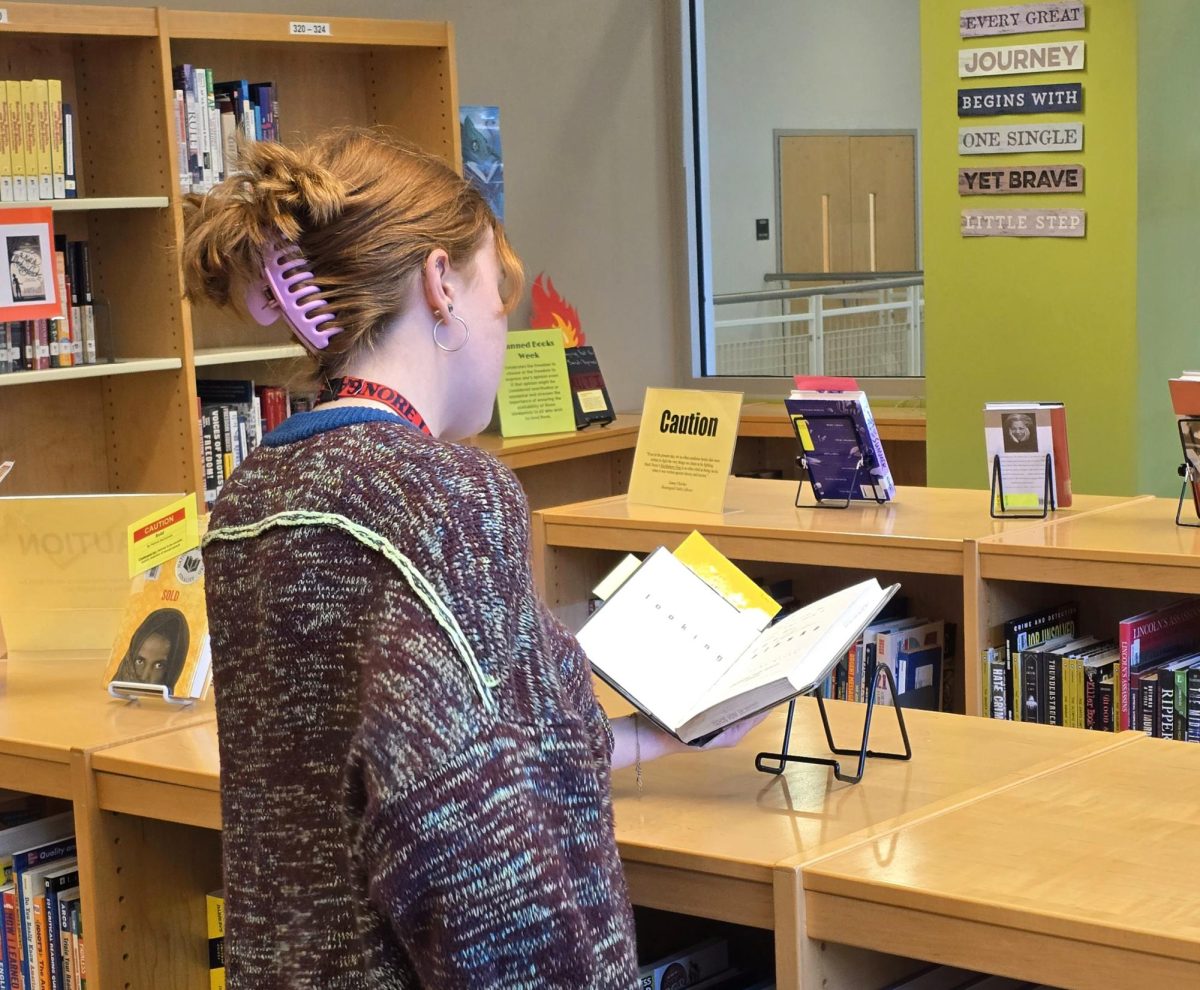
A plethora of books are featured on the shelves of the Learning Commons. It is banned books week at Linganore High School (LHS) and dozens of books that have been challenged or banned are put on display to educate students on why book bans happen.
The reasons for banning the showcased books ranges from depictions of sexual assault, content regarding fictional use of magic, and equity, diversity and inclusion content. Equity, diversity and inclusion content is used to refer to books that focus on the stories and struggles of characters belonging to marginalized communities.
LHS Media Specialist Marsha Thompson set up the annual displays in the Learning Commons that are open for classes and students to observe. Among the shelves were examples of books that had been banned or challenged. Also featured were signs, posters and interactive maps and slideshows.
The restrictions placed on who can access a book in a school library depend on whether a book is challenged or banned. When books are challenged, it means a formal attempt to remove or restrict the materials has been made. If the challenge is successful, the book is then banned.
“Books get banned because a person or a group of people feel the ideas in the book are not suitable for some other group,” Thompson said. “[Banning books] limits the ideas that you have exposure to.”
Some of the most popular books that have been banned from school curriculums include “The Outsiders” by S.E. Hinton, “A Clockwork Orange” by Anthony Burgess, and “Where the Sidewalk Ends” by Shel Silverstein. All books contain themes regarding, among other things, rebellion and the questioning of authority.
“People are absolutely shocked that certain books are not allowed; people cannot believe it,” LHS English teacher Mary Troxel said “‘The Lorax’ was a big one last week,”. “But that is the whole issue. If you are not aware, you do not have the ability to fight against it or to find access to argue that maybe people shouldn’t limit access.”
The top four most challenged books of 2024 were “The Bluest Eye” by Toni Morrison, “The Perks of Being a Wallflower” by Stephen Chobosky,“Gender Queer: A Memoir” by Maia Kobabe and “All Boys Aren’t Blue” by George M. Johnson. “The Bluest Eye” was challenged for its content regarding child sexual abuse, while the other novels were challenged for containing explicit LGBTQIA+ content and characters.
“[I’ve noticed] queer topics are censored heavily because it’s deemed ‘inappropriate,’” Linganore sophomore Oliver Fuller said. “It’s really unfortunate that so much is censored.”
Along with LGBTQIA+ storylines, other common reasons for books to be challenged and banned are for containing racism, language that is not deemed age-appropriate, depictions of sexual content and violence.
In 2024, Maryland passed the Freedom to Read Act, which makes the process of banning or challenging a book harder. The act prevents books in schools and public libraries from being removed because of the background of the author or because of religious disapproval. The act also mandates that school systems cannot remove a challenged book until after the review process is complete.
Despite consistent challenges to censor and ban books from public libraries, there are many groups that are fighting against this. Unite Against Book Bans, for example, is an initiative to empower people to read challenged and banned books and stand against any attempt at removal of free speech. Stand with Unite Against Banned Books and pick a banned or challenged book to read from here.